
1. Why “Safe Enough” Isn’t Enough
When it comes to gas handling, compliance is only the beginning. True safety happens in the quiet, unseen moments - when a technician pauses to ground equipment before filling, inspects a hose fitting under vacuum, or records a small leak that prevents a costly emission and/or contamination of the gas being handled.
These small acts reflect more than procedural discipline; they form the foundation of a safety culture that protects people, equipment, and the environment long after audits are over.
At DILO, our mission revolves around zero emissions and operator safety . We understand the daily challenges technicians face because we’ve been there — in substations, on GIE , and in service bays where conditions change fast and every connection matters.
While regulatory frameworks like OSHA, CARB, NYDEC, MASSDEP and the EPA set essential baselines for safe operation, long-term reliability requires something more profound: shared accountability and continuous learning.
SF₆ (sulfur hexafluoride) is a potent insulating gas, but its properties also demand respect. According to the US EPA – SF₆ basics, potency & atmospheric lifetime, this compound has a global warming potential roughly 25,200 times greater than CO₂. It can persist in the atmosphere for more than 3,000 years. That’s why responsible handling is a regulatory requirement and also an environmental obligation.
The question isn’t “Are we compliant?” It’s “Are we safe enough to trust our process every single time?”
2. Small Steps, Big Impact: The Habits That Prevent Incidents
Regulations define what must be done. A strong SF₆ safety culture defines how it’s done, consistently, thoughtfully, and with pride.
Even the smallest procedural lapses can create serious risks: contamination, premature equipment wear, by-passing maintenance schedules, or unexpected gas emissions. DILO’s field experience shows that four micro-practices, when adhered to, will reduce incidents, downtime, and non-compliance events.
1. Hose Preparation Under Vacuum and Capping Connections
Keeping hoses under vacuum and properly capping the ends prevents moisture ingress and particulate contamination—both of which can compromise gas purity and equipment integrity. Maintaining this level of cleanliness ensures that SF₆ remains uncontaminated and that circuit breakers, switchgear, and other gas-insulated equipment continue to meet manufacturer specifications. It’s a simple preventive step that directly extends equipment life and helps protect against costly arcing failures.
At DILO, we believe that safe, efficient gas handling begins with proper training. Through our in-person and virtual SF₆ Safety and Handling courses, technicians gain hands-on and theoretical knowledge of best practices for every aspect of gas work—from hose evacuation and inspection to leak prevention, moisture control, and purity verification. These comprehensive programs ensure that every connection and reconnection meets the highest standards for safety, reliability, and environmental compliance.
2. Grounding Verification
Before connecting to gas-insulated equipment, a quick continuity test can prevent electrical discharge events. Grounding verification may seem routine, but during gas recovery or filling, static buildup can ignite flashovers or damage sensitive instruments. Making this a non-negotiable step not only protects personnel but also demonstrates leadership commitment to operational discipline.
3. PPE and Work Zone Readiness
Pre-job safety reviews save lives and prevents emissions. Eye protection free of scratches, gloves rated for the right voltage, and grounding mats properly positioned — each detail minimizes risk. Encouraging every crew member to conduct a two-minute PPE check before handling cylinders or couplings, a team can prevent dozens of minor hazards from ever escalating into incidents.
4. Gas Log Discipline
Gas log accuracy is one of the most underrated safety tools. Comprehensive records of gas movement, cylinder IDs, weights, and recovery volumes support traceability for EPA and CARB audits and reveal patterns that help identify leaks early. Proper logs also simplify preventive maintenance scheduling and support carbon accounting initiatives.
These small habits may appear administrative, but over time they produce a measurable reduction in emissions, downtime, and corrective maintenance costs. They’re what transform compliance into culture.
3. The Role of Training: From Compliance to Competence
Knowledge closes the gap between what’s required and what’s possible. DILO’s approach to training recognizes that regulations evolve, technology advances, and experienced technicians still benefit from refreshed best practices.
The SF₆ gas handling and safety training offered by DILO blends regulatory compliance with hands-on, scenario-based instruction. Courses cover gas recovery, analysis, leak detection, and documentation—giving technicians a complete understanding of both the “how” and the “why.”
DILO’s commitment extends beyond compliance certification. Through DILO Academy, participants access structured e-learning, instructor-led courses, and recertification paths that meet IACET-accredited continuing education standards. Each course integrates environmental science, risk management, and practical exercises designed for the realities of fieldwork.
A key principle drives every program:
“A DILO-trained technician doesn’t just know the rule — they understand the reason.”
Graduates learn how to interpret SF₆ safety data sheets (SDS), evaluate cylinder conditions, and respond to real-world complications such as contaminated gas or mislabeled storage tanks. This depth of knowledge builds confidence, which directly translates to safer performance on the job site.
Even organizations with robust EHS and training departments find that continuous training reinforces consistency across shifts, contractors, and geographies. For new technicians, accredited training establishes a baseline of competence. For seasoned staff, it sharpens habits that can dull over time and limits complacency..
When technicians know why hose prep matters or how to recognize early signs of valve and hose degradation, safety becomes instinctive, not reactive.
4. Leadership’s Role: Setting the Tone
An authentic SF₆ safety culture begins at the top. Leadership behaviors shape whether “safety” is seen as an obligation or a shared value.
Supervisors who pause operations for an inspection rather than rushing to meet a schedule send a clear message: people and process come first. Recognizing team members who identify near-misses or log detailed gas records reinforces that behavior as a norm.
When leaders model discipline, teams follow. When they reward awareness, safety becomes part of identity.
DILO partners with utilities, OEMs, and industrial operators to develop standard operating procedures (SOPs) that codify these expectations. Together, we translate regulatory text into actionable workflows, specifying grounding checks, PPE inspection sequences, gas-log templates, and incident reporting frameworks.
Organizations that integrate these SOPs into their performance management systems report stronger retention, fewer unplanned outages, and higher audit readiness.
In our field experience, leadership engagement consistently correlates with lower incident rates. Safety meetings that include senior voices, not just compliance staff, signal that protection and precision matter to everyone, not just the safety team.
5. How Safety Culture Reduces Incidents Beyond Compliance
It’s one thing to meet an inspection checklist. It’s another to change behavior so incidents rarely occur in the first place.
A compliance-only mindset focuses on avoiding penalties. A safety culture mindset focuses on protecting people and preserving uptime.
When technicians internalize SF₆ safety habits such as grounding, PPE inspection, hose evacuation, and disciplined logging, they interrupt the most common failure chains before they escalate. In DILO-supported facilities, these behaviors have translated into tangible improvements: fewer accidental releases, faster maintenance cycles, and greater accuracy in environmental reporting.
Besides compliance, a mature safety culture supports sustainability and organizational resilience. Technicians empowered to report minor anomalies, such as subtle pressure drops or corroded fittings, help prevent unplanned gas losses that can cost thousands of dollars and trigger regulatory scrutiny.
Culture also amplifies innovation. When employees feel responsible for continuous improvement, they propose better labeling systems, suggest upgraded leak detectors, or recommend adding new sensors to track gas purity in real time. Those bottom-up ideas keep organizations ahead of regulatory change rather than chasing it.
6. The Cultural Mechanics: What It Takes to Embed SF₆ Safety
Building a safety culture is both behavioral and procedural. It’s about creating feedback loops, setting clear expectations, and celebrating wins.
- Routine Reinforcement: Begin every shift with a brief hazard review or micro-training segment. Repetition transforms awareness into muscle memory.
- Accessible Documentation: Ensure SF₆ SDS and operating checklists are easy to locate in both digital and physical form. Crews are more likely to reference materials when they’re integrated into daily workflows.
- Transparent Metrics: Share gas loss data, training completion rates, and near-miss trends in team meetings. When performance is visible, accountability grows.
- Cross-functional Ownership: Encourage collaboration between maintenance, EHS, and procurement teams. Each group influences how gas is stored, used, and recycled.
- Continuous Learning: Stay current with evolving best practices by scheduling regular refreshers through DILO Academy or enrolling in Virtual SF₆ Safety and Handling Training. These ongoing learning opportunities ensure your team remains confident, compliant, and prepared for every gas-handling challenge—and don’t forget to make plans to attend the 2026 Insulating Gas Management Seminar (IGMS) to stay at the forefront of industry innovation and safety.
A thriving safety culture builds resilience. It empowers workers to act decisively, anticipate risks, and support one another in maintaining a zero-emission workspace.
7. Beyond Training: Equipment and Environment Matter
Training is the cornerstone, but tools and environment reinforce safe behavior. Technicians depend on well-maintained handling equipment, couplings, analyzers, and leak detectors to uphold zero-emission standards.
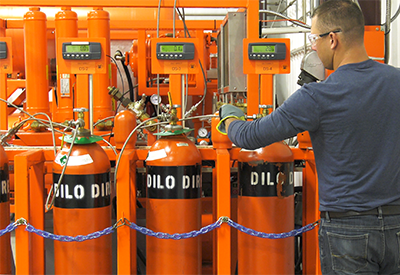
Routine calibration of leak-detection equipment ensures accurate readings, while proper storage practices prevent contamination and moisture absorption. Clear labeling on cylinders and the use of certified gas storage cylinder weighing scales improve traceability, helping teams verify fill volumes and reconcile logs accurately.
Simple investments, such as grounding reels, quick-connect couplings, and automatic shut-off valves, drastically reduce the risk of accidental discharge. Combining these engineered controls with behavioral discipline, organizations move from reactive compliance to proactive prevention.
8. Case Insight: What Continuous Learning Looks Like
Consider a regional utility that partnered with DILO to audit its SF₆ handling process. Although the utility had a strong compliance record, minor inconsistencies in gas logs and hose maintenance were increasing downtime.
After enrolling field teams in SF₆ gas handling training, they implemented new SOPs emphasizing hose evacuation, grounding verification, and weekly leak audits. Within six months, the utility reported:
- 40% fewer gas discrepancies during audits
- 30% faster turnaround times for maintenance tasks
- Zero recordable gas releases
These measurable improvements didn’t come from new regulations — they came from people practicing safety with intention. That’s the power of culture over compliance.
9. Looking Ahead: The Future of SF₆ Safety
As the industry transitions toward alternative gases and stricter environmental reporting, the importance of safety culture will only grow. Emerging standards will require more documentation, sensor integration, and interdepartmental coordination than ever before.
Organizations that have already invested in training and cultural maturity will adapt faster, with fewer operational disruptions. As DILO continues to expand its global training network, including virtual and hybrid courses, maintenance teams can stay ahead of both technological and regulatory change without leaving their facilities.
The long-term vision is clear: every gas-handling task performed safely, every cylinder accounted for, every technician empowered to lead by example.
Strengthen Your Safety Culture
Safety isn’t a box to check — it’s a mindset to cultivate that includes management accountability.
When your team and management embrace SF₆ handling as both a responsibility and a craft, reliability and compliance become natural outcomes. If you’re refreshing your safety procedures or onboarding new technicians, DILO can help you go beyond compliance and build a legacy of excellence.
Start today with:
- Virtual SF₆ Safety and Handling Training – instructor-led courses designed to replicate field conditions and reinforce core procedures.
- SF₆ Gas Handling Training – accredited programs recognized worldwide for their technical rigor and adherence to the highest safety standards.
- DILO Academy – on-demand courses and certification pathways that promote continuous learning and operational excellence across your organization.
- Insulating Gas Management Seminar (IGMS) 2026 – join industry leaders and peers to explore the latest advancements, share best practices, and strengthen your network on February 25-26, 2026 in Clearwater Beach, FL.
Empower your teams. Protect your assets. Lead your industry in SF₆ safety culture.
Have training gaps or onboarding needs? Reach out to DILO—our team can help you build a tailored SF₆ safety program that meets your goals.