
Gas-Insulated Lines (GIL): What They Are, How They Differ from GIS, and Why They Require Different Gas Handling
Moving large amounts of electricity through a crowded city, beneath a river, through a mountain, or away from a major generation site creates a problem conventional transmission technologies cannot always solve efficiently.
The application of Gas Insulated Lines (GIL) combines high transmission capacity with a compact, enclosed design that can be routed through tunnels, shafts, underground corridors, and other challenging environments. Manufacturers build GIL systems for rated voltages up to 550 kV and transmission capacities of several thousand MVA.
But GIL also creates a challenge of its own: gas handling at a completely different scale.
Understanding that challenge starts with learning what GIL is and why it shouldn't be confused with GIS.
What Are Gas-Insulated Lines (GIL)?
A gas-insulated transmission line is a high-voltage transmission system in which an aluminum conductor runs concentrically inside a grounded metal enclosure.
The space between them is filled with a pressurized insulating gas, traditionally pure SF₆ gas or, in many GIL designs, a mixture of SF₆ and nitrogen (N₂).
The gas provides the electrical insulation needed to separate the energized conductor from the enclosure safely.
In simple terms, think of GIL as an insulated bus duct engineered for high-voltage, high-capacity power transmission.
The technology is particularly valuable where overhead transmission is impractical or undesirable. Depending on the system, GIL can be installed:
- In underground tunnels
- In vertical or inclined shafts
- Above ground
- Through mountainous terrain
- Across challenging infrastructure corridors
- In direct-burial applications
Published GIL systems operate at voltages up to 550 kV and rated currents of several thousand amperes. That combination makes GIL particularly suited to transmitting very large amounts of power where available space or routing options are limited.
Unlike conventional high-voltage cables, GIL does not rely primarily on a thick layer of solid dielectric material around the conductor. Instead, the pressurized gas inside the enclosure provides the primary electrical insulation.
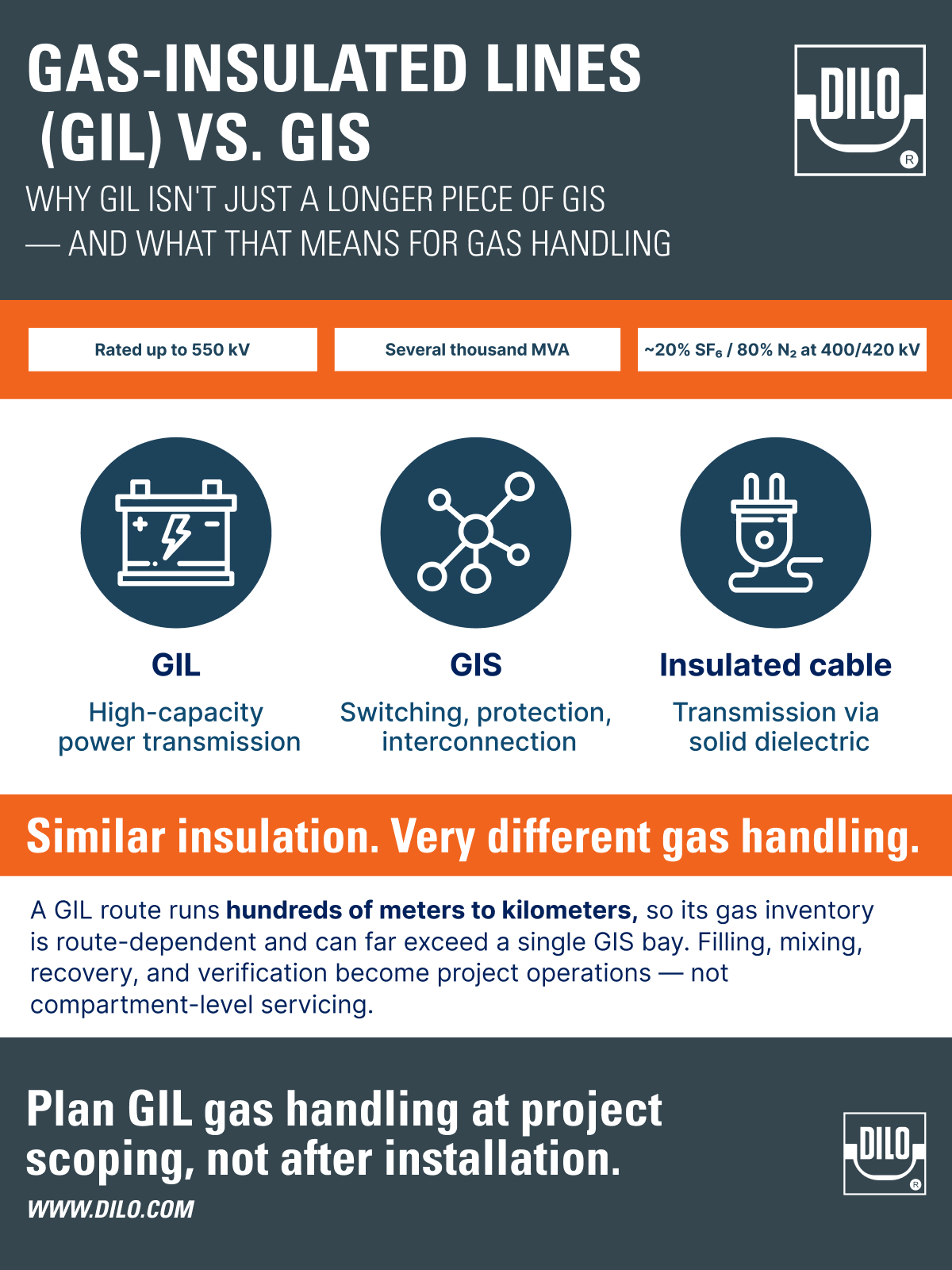
GIL vs. GIS: Similar Insulation, Very Different Jobs
The acronyms are similar, but the equipment serves very different purposes.GIS switchgear and GIL can both use pressurized insulating gases and enclosed conductors, but they serve fundamentally different functions within a high-voltage network.
Purpose and Design
A GIS substation brings switching and control equipment into a compact, gas-insulated enclosure. Depending on the configuration, that can include circuit breakers, disconnectors, grounding switches, instrument transformers, and insulated busbars.
GIL does something different. It transmits power from one location to another.
A GIL route can extend for hundreds or thousands of meters/feet, with some systems spanning many kilometers/miles. Instead of concentrating switching functions within a substation footprint, the GIL acts as the high-capacity transmission connection itself.
That distinction has major consequences for gas handling.
|
Characteristic |
GIL |
GIS |
Insulated Cable |
|
Primary Function |
High-capacity power transmission |
Switching, protection, and substation interconnection |
Power transmission |
|
Typical Route |
Hundreds of meters to kilometers |
Concentrated within substations |
Meters to many kilometers |
|
Primary Insulation |
Pressurized gas or gas mixture |
Pressurized insulating gas |
Solid dielectric insulation |
|
Gas Inventory |
Potentially very large and route-dependent |
Compartmentalized and equipment-dependent |
No insulating-gas inventory along cable |
|
Gas Handling Focus |
Large-volume filling, mixing, recovery, and verification |
Individual compartment servicing |
Not applicable in the same way |
|
Typical Installation |
Tunnels, shafts, direct burial, above ground |
GIS substations |
Underground, subsea, tunnels and other routes |
Gas Volume Changes the Equation
One of the biggest differences between GIL and GIS is scale. GIS equipment divides into defined gas compartments around specific pieces of substation equipment.
A long GIL route, by contrast, contains a much larger overall internal volume distributed across multiple line sections. The exact gas inventory varies significantly with line length, enclosure dimensions, pressure, voltage class, gas mixture, and compartment design.
That means there is no meaningful universal answer to "How much SF₆ does a GIL contain compared with GIS?"
It can be confidently said that a major GIL installation may require handling a substantially larger total volume of insulating gas than an individual GIS bay. Filling, evacuation, recovery, storage, and mixture preparation therefore become major project operations rather than routine compartment-level servicing.
Why GIL Uses SF₆/N₂ Gas Mixtures
Utilities have historically used pure SF₆ in high-voltage equipment because of its excellent dielectric properties.
However, GIL presents an important distinction: the gas primarily provides insulation rather than performing the arc-quenching function required in circuit breakers.
That creates an opportunity to reduce the amount of SF₆ by combining it with nitrogen.
A well-established second-generation GIL design uses approximately 20% SF₆ and 80% N₂ at 400/420 kV. Other ratios are used across different applications, voltage classes, and equipment designs, so 20/80 should not be treated as a universal GIL specification.
Why use the mixture?
First, nitrogen can constitute a substantial portion of the insulating medium, thereby reducing the total quantity of SF₆ required.
That's significant because SF₆ is an extremely potent greenhouse gas. The International Panel on Climate Change (IPCC) Sixth Assessment Report (AR6) cites a global warming potential of approximately 25,200 times that of CO₂.
Atmospheric SF₆ trends also reinforce why preventing emissions remains an important consideration throughout the equipment lifecycle.
At the same time, combining two gases introduces a requirement pure-gas handling doesn't have:
The mixture itself must be controlled.
The Gas Handling Challenge: Why GIL Is Fundamentally Different
A GIL isn't simply a longer piece of GIS. From a gas-management perspective, its scale and use of gas mixtures create a distinct set of requirements.
1. Large Gas Volumes Require High-Capacity Equipment
Evacuating, filling, or recovering gas from long GIL sections can involve substantial quantities.
Equipment therefore has to be sized for the required throughput and storage capacity. Filling speed, hose dimensions, pumping capacity, storage strategy, and logistics all play important roles in commissioning and maintenance planning.
The same applies in reverse. When a section requires maintenance or decommissioning, the insulating gas must be recovered efficiently rather than vented to the atmosphere.
2. SF₆/N₂ Mixtures Must Be Prepared Accurately
Working with a mixture adds another variable: composition. The specified SF₆/N₂ ratio is part of the insulation design, so on-site preparation requires controlled dosing and mixing rather than simply transferring a single gas into the equipment.
After filling, gas analysis verifies that the resulting mixture meets the project's required specifications.
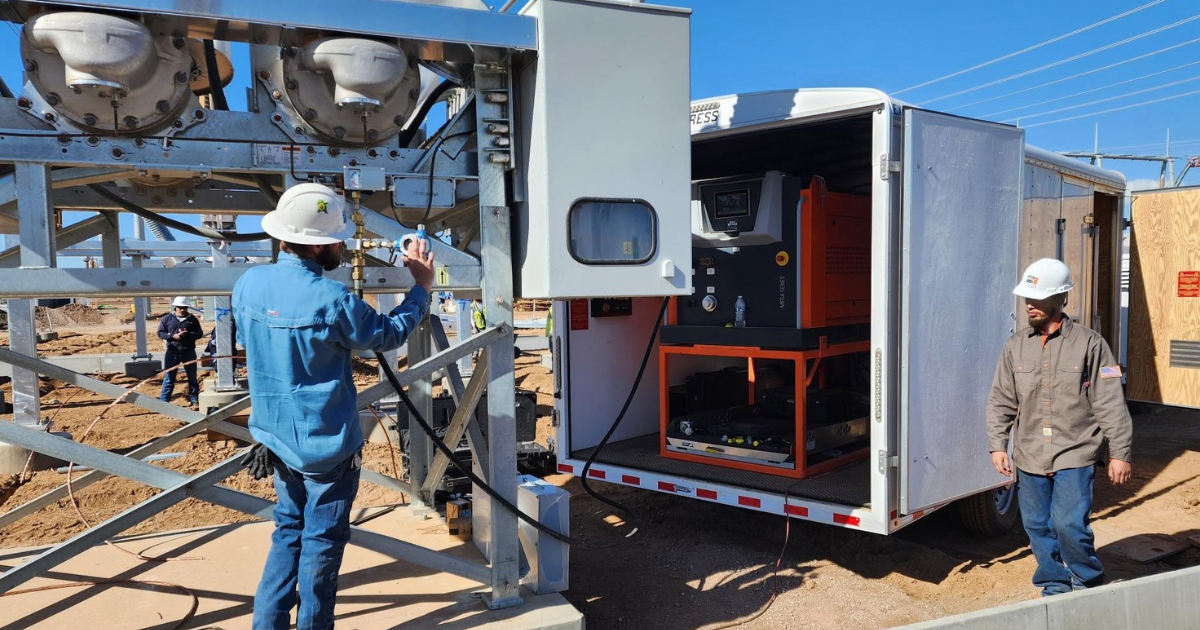
This is where specialized insulating gas handling equipment becomes particularly important. The operation may involve evacuation, controlled addition of the individual gases, homogenization, pressure control, and subsequent analysis.
3. Monitoring Extends Along the Route
GIS monitoring is typically organized around defined equipment compartments.
GIL may have multiple gas compartments distributed along an extended transmission route. Depending on the system design, a GIL route may be divided into multiple gas compartments distributed along the transmission route. Pressure or density monitoring may therefore need to be coordinated across several sections rather than treated as a single, centralized gas-handling and analysis point.
If gas density changes unexpectedly, trained and certified technicians need to identify the affected section, investigate the cause, and carry out any necessary gas handling while minimizing emissions.
4. Environmental Accountability Doesn't End After Commissioning
The environmental importance of SF₆ makes containment essential throughout the gas lifecycle. That includes initial filling, testing, maintenance, recovery, temporary storage, gas analysis, and eventual decommissioning.
For GIL projects, the large overall gas inventory makes efficient recovery and low-emission handling especially important. It also increases the importance of accurate documentation: teams need to know how much gas entered the system, how much was recovered, and where any discrepancies occurred.
DILO Equipment Designed for GIL Gas Handling
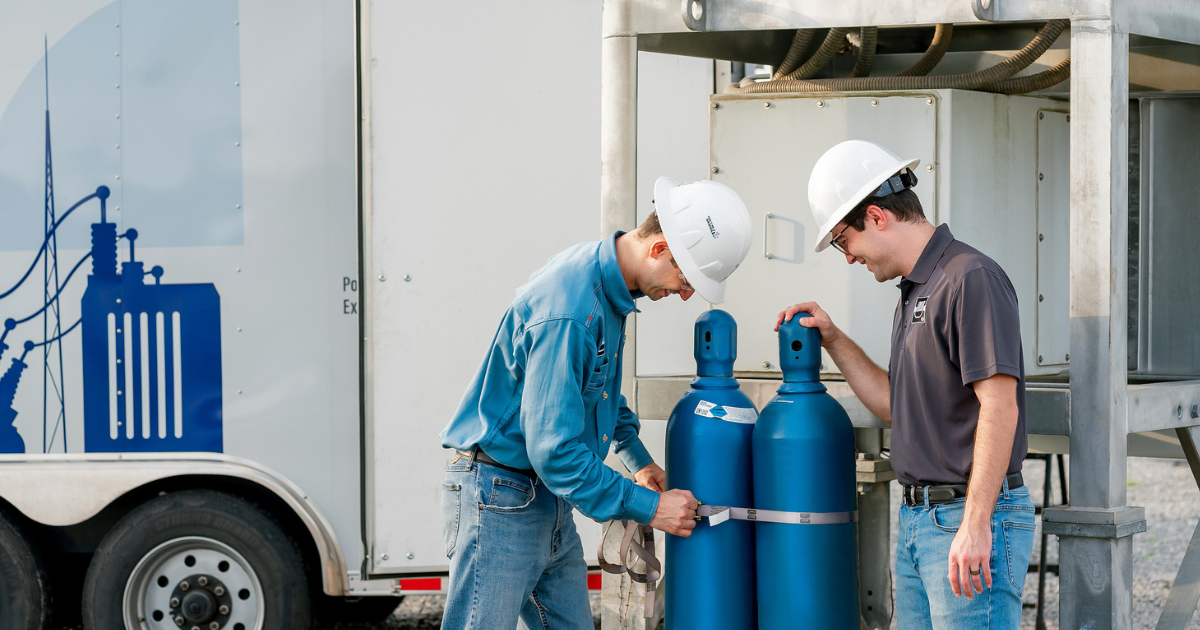
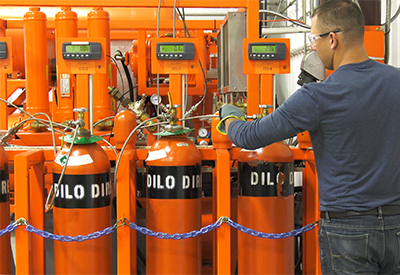
Depending on the project requirements, DILO can provide:
- Powerful vacuum pump units with Roots blowers for evacuating large-volume GIL sections
- Mixing and filling plants for preparing homogeneous SF₆/N₂ gas mixtures
- High-pressure recovery units for recovering and storing gas mixtures
- Large mobile filter units for drying gas
- Cylinder bundles and other equipment for storing and transferring gas mixtures
Because every GIL installation is different, equipment should be configured around the line volume, specified gas mixture, operating pressure, required processing time, and on-site logistics.
Where GIL Makes the Most Sense
GIL isn't intended to replace every overhead line or high-voltage cable. Its value becomes clearest when a project needs to transmit a large amount of power but faces physical, environmental, or routing constraints.
Applications can include connections to major generation facilities, hydroelectric plants, urban substations, tunnel routes, river or mountain crossings, and other high-capacity transmission corridors.
Grid expansion is making those constraints increasingly relevant. Renewable generation, new high-load facilities, and changing transmission patterns are driving demand to move more electricity through areas where building new overhead corridors may be difficult.
GIL Demands a Gas-Handling Strategy of Its Own
GIL and GIS share some technology, but their gas-handling requirements should not be treated as interchangeable.
Long transmission distances mean larger overall gas volumes. SF₆/N₂ insulation introduces requirements for mixture preparation and verification. Distributed compartments change monitoring and maintenance workflows. And the environmental impact of SF₆ makes recovery and emission prevention critical throughout the system's lifecycle.
For utilities, EPC contractors, and transmission planners evaluating GIL, gas management therefore needs to be considered from the beginning of the project, not after installation is complete.
Planning a GIL commissioning, maintenance, or decommissioning project? Consider a quality DILO SF₆ handling device specifically designed for gas-insulated lines, or contact our team to discuss your line volume, gas mixture specifications, processing requirements, and on-site logistics.